
Materia Aromatica
France
Highland lavender, garrigue chemotypes, mountain conifers and the absolutes of the south.
See the oils ↓Materia Aromatica · Origin
France is usually read as the country of lavender. Lavender and lavandin account for five of the thirty-two French materials in this range. The rest is conifers, umbellifer roots and seeds, the thyme and rosemary chemotypes of Provence, and a group of absolutes that belong to the old extraction trade of the south-east.
01 · The Region
Plateau, garrigue and forest
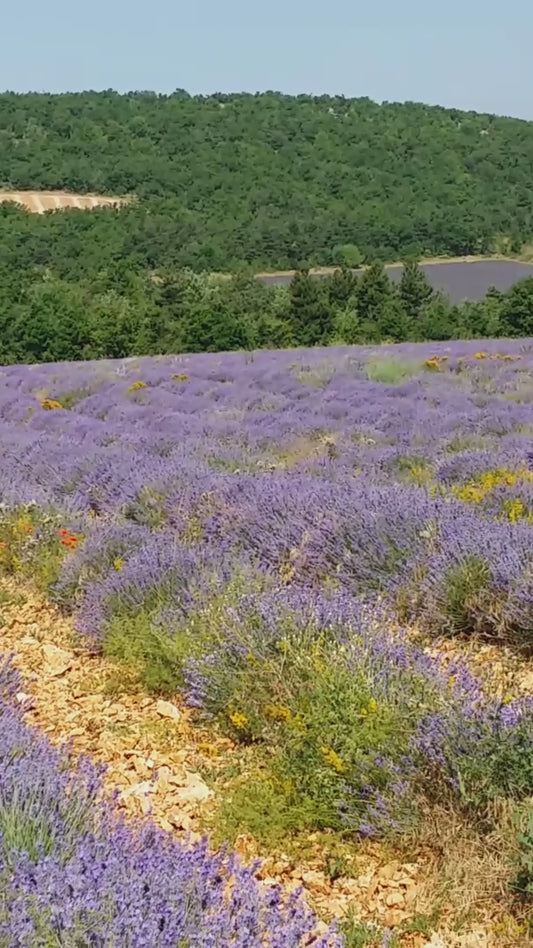
French aromatic production sits in three bands. The limestone plateaus of Haute-Provence carry true lavender, which grows on high, dry ground, with lavandin planted on the lower slopes below it. Beneath them lies the garrigue: thyme, rosemary, oregano and helichrysum on stony, sun-exposed soils, much of it wild-harvested. Above and to the north stand the forests of the Alps and the Massif Central, the source of the pines, firs and juniper.
The garrigue is where chemotype matters most. Thymus vulgaris in southern France grows as distinct chemical races, some phenolic and some not, often within short distances of one another. Rosemary behaves in a similar way. Grasse and the towns around it built the extraction trade, and the absolutes in the range follow that line: flowers, buds and dried grasses taken by solvent rather than steam.
Plateau
Lavender and lavandin
True lavender from the highlands, lavandin from the lower ground. Linalyl acetate and linalool lead.
Garrigue
Herbs and chemotypes
Thyme, rosemary, oregano, helichrysum and myrtle. One species can yield several distinct oils.
Forest
Conifers and roots
Scots and sea pine, Douglas and giant fir, juniper, Atlas cedar needles and angelica root.
Extraction
The absolutes
Narcissus, hay, cassis bud, lavender and seaweed. Perfumery materials first.
-
Regular price From $15.00Regular priceUnit price per
-
Regular price $60.00Regular priceUnit price per
-
Regular price $25.00Regular priceUnit price per
-
Regular price From $23.80Regular priceUnit price per
$34.00Sale price From $23.80Sale -
Regular price From $12.00Regular priceUnit price per
-
Regular price From $26.00Regular priceUnit price per
-
Regular price From $28.00Regular priceUnit price per
-
Regular price $19.00Regular priceUnit price per
-
Regular price $21.00Regular priceUnit price per
-
Regular price $28.00Regular priceUnit price per
-
Regular price $19.00Regular priceUnit price per
-
Regular price $19.00Regular priceUnit price per
-
Regular price $34.00Regular priceUnit price per
-
Regular price $14.00Regular priceUnit price per
-
Regular price $28.00Regular priceUnit price per
-
Regular price $25.00Regular priceUnit price per
-
Regular price $19.00Regular priceUnit price per
-
Regular price $18.00Regular priceUnit price per
-
Regular price $26.00Regular priceUnit price per
-
Regular price $21.00Regular priceUnit price per
-
Regular price $15.00Regular priceUnit price per
-
 Sold outRegular price $86.00Regular priceUnit price per
-
 Sold outRegular price $21.00Regular priceUnit price per



02 · The Range
Ten oils across four bands
03 · Side by Side
Chemotype, part and tree
Start with thyme. Thyme (Carvacrol) (No. 2811), Thyme, Mild (Thujanol) (No. 2881) and Thyme, Sweet / Geraniol (No. 2861) are all Thymus vulgaris from France. The first is phenolic and hot. The second is built on thujanol and linalool. The third is led by geranyl acetate and geraniol and reads almost floral. Botanical name alone does not identify a thyme oil; the chemotype does.
Rosemary repeats the lesson in a narrower range. Rosemary Highland, France (No. 2605) is led by 1,8-cineole. Rosemary, Verbenone (No. 2620) and its wild Superior grade (No. 2622) carry bornyl acetate and verbenone, with far less of the oxide. On strips the cineole oil is fresh and sharp; the verbenone oils are softer and more herbaceous.
Then the conifers. Pine, Scots (No. 1475) and Sea Pine (No. 1770) are pinene oils, dry and resinous. Fir, Douglas (No. 2765) adds sabinene and terpinolene for a brighter, citric top. Giant Fir (No. 2772) carries bornyl acetate, the ester that gives fir oils their rounder, balsamic tone. Both firs are North American species grown in French forests.
04 · In Practice
From diffuser to perfumer's organ
The lavenders, clary sage and the non-phenolic thymes are the general materials of this shelf: diffusion, massage blends, bath preparations and skincare formulation. Clary sage and lavender meet in the classic herbal-floral accords of natural perfumery as middle notes. Helichrysum is used at low proportion in skincare formulation and as an unusual honeyed middle note.
The conifers belong to diffusion and to bath and massage blends where a resinous, open quality is wanted. Carvacrol thyme and oregano vulgare are phenolic and call for high dilution in any skin application. Birch is almost entirely methyl salicylate and is kept out of preparations for children. The absolutes are perfumery materials. Narcissus, hay and cassis work in small proportion and are best learned singly on a strip before blending.
Essential oils are for aromatic and topical use. Dilute before applying to skin. Keep out of reach of children.